A little while ago, I ran into a South Korean movie called Milyang – which translates into “Secret Sunshine”. As Usually I’m a bit weary of Asian movies (they tend to go on forever), but this time I would not get stopped and was determined to check it out. And I’ve got to say that, even if it did run for 142 minutes, I did enjoy it a lot. Maybe I’m maturing? Nah, it’s probably just that this movie is really good.
The Eternal Downwards Spiral
Other than a basic theme (“coping with tragedy”), it’s near impossible to say what this movie is about, exactly. The premise is quite simple: Sin-ae, a thirtysomething mother, moves with her son Jun to Miryang, the town where her dead husband was born. After that things get a bit hairy – things happen and happen and happen, much reminiscent of that other thing people try to show us in the cinema so often: life.
That’s just about it, really. You can’t really say that this movie tells a certain story, because it doesn’t. Picture Magnolia – a handful of characters which are linked share the theme of “redemption” in their storylines which other than that have nothing to do with each other – but remove the “handful of characters” bit: all these stories just happen to this one woman (performed by the more than great Do-yeon Jeon, who does an awesome job at convincing us that it’s all real), all after another.
In All…
I like that: it’s a kind of unusual way of storytelling and we were really wondering how it would (or could) go on at certain points throughout the film. The end of the movie fitted the feeling that we were granted a small look into someone’s life – a look without a firm beginning or end. You get a picture and you can check it out, but you can’t see it all. You can only see what’s in the frame, not what’s on the edge, or the moments leading to the taking of the picture. All you can do is invent those occurances as you see fit.
One little disclaimer though before I send you off to the movies to watch this: it goes to the bone. It never goes beyond that, but it does get pretty dramatic. Oddly enough though, me nor the person with whom I watched this movie, felt really bad afterwards. We just both fell silent, and had to think about it for a while. Interesting.
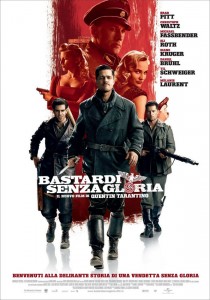
Whenever a new Tarantino movie hits the silver screen, I’m a bit cautious. You see, I’m not a big fan of his work. I don’t really respond all that well to unnecessary realistic violence in movies (case in point: I tend to dislike Zac Snyder movies too). But there’s the thing: the violence featured in Inglourious Basterds is neither unnecessary nor realistic. So I found myself enjoying this movie a lot more than I thought I would.
Wolfenstein meets Little Red Riding Hood
The story consists of two different storylines: one tells the tale of the Inglourious Basterds, an allied terror unit in World War II with as a single goal killing (and scalping) Nazis. The other revolves around a Jewish French woman and the plans of having a big Nazi premiere there. Both storylines obviously come together at the end, but before that there is a lot of frolicking around in typical Tarantino fashion: with loads of dialogue, resulting in violence.
At first, the dialogues were reminiscent of Death Proof – which I disliked thoroughly. Soon, however, one could tell the big difference between Death Proof and Inglourious Basterds: the cast. This wonderful cast actually carries the insane amounts of insane dialogue, instead of getting carried away by it. Some of the more complicated lines – in four languages nonetheless – were uttered by Christoph Waltz. It was obvious he had studied them thoroughly and knew what he was doing. Stunning, stunning display.
Once upon a blabla
Inglourious Basterds tries to be a bit of a fairy tale. It never tries to be realistic, but keeps the setting correct so it’s credible enough. You know the events at the end of the movie never happened, but – in the world of Tarantino himself – they could have happened (but hell could also freeze over). Also, you don’t really relate to the characters (a thing I’ve actually never done in any Tarantino movie, come to think of it) – whether they live or die, it’s the same thing. You just hope they go out with a bang.
[spoiler]I do have to say though: the Basterds killing Hitler? The manchild in me says that’s pretty awesome. Even though the whole burning cinema fire was poorly executed, littered with continuity errors and a display of very, very bad taste in humanity.[/spoiler]
So it’s a bit of a side story. In that way, it’s a smart plan of Tarantino’s to cut the story into five smaller bits – chapters. Sure, fine and dandy, but this does not work if your first three chapters combined are the length of the fourth or the fifth respectively. The first three chapters felt like introduction, and it wasn’t until the last two that the audience could see where Tarantino was going with this. Had this been an unknown director, he wouldn’t have gotten away with it, I think.
In all…
Even though I dislike Tarantino’s movies, I would recommend you go and see this one. It’s pretty fun. The violence has been kept to a minimum, and this time around, it’s not about wildly ejaculating but all about the build-up to the orgasm. Scenes go on for ever as you can feel the tension slowly rising. It’s something I have rarely seen with Tarantino; he’s usually so gun-ho that the load has already been lost before the thing even got off the ground.
And yes, you can go Freudian on that.
Favourite Quote: Lt. Raine: Donny! Got us a German here wants to die for country. Oblige him.
I’m starting to see an emerging pattern here. You see, I liked Harry Potter and the Goblet of Fire a lot, but other people hated it. And, now I like Harry Potter and the Half Blood Prince a lot – and yes! There is a lot of hate once more. Why the hate, people, why the hate? This movie does the thing a penultimate movie ought to do, and it’s the one movie to stay – in my opinion – closest to the book in style and substance (and if it does stray, I think it’s justified).
Lookit the pretty pictures!
Let me say this first: for me, this is without a doubt the prettiest Harry Potter movie to date. Yes, I consider it to be even prettier than the much lauded Prisoner of Azkaban. Yes, that movie was the best and it was the greatest and so on, but in all fairness it did notlook as good as this one. Obviously, this one builds rather heavily on Azkaban in art style – moreso than the two previous ones. There are some shots in here that are almost art.
Oh, but dear writer, we know you know nothing of art! Well, you’ve got me there. But when I looked at certain shots, I saw a fan of surrealism – of Magritte. Most of these shots revolved around Draco Malfoy – more on him later – or his immediate surroundings. His black suit, the houses his mother was running through on her way to a certain someone, the vanishing cabinet… they all looked nightmarish and absurd. And unbelievably pretty. It gives me hope that David Yates could actually save the last book. But then I remember a thing called “wand lore”.
And it has to be said: Nicholas Hooper did a great job composing the music for this film. It fits the mood perfectly. Some other movies had great soundtracks as well (I’m thinking Azkaban and the Goblet of Fire), but this one was a lot better than all the others. It has something magical – just like the movie has something magical, something indescribable that the other movies don’t have. The magic feels more… fresh and new – but ancient at the same time. As if it were a character on its own, symbolized into Dumbledore (this you can see clearly in the first scene, when he appears in front of “Magic” billboard).
Snogging! Snogging!
I remember watching “The Life Aquatic” a while ago and feeling like a little boy watching National Geographic again. The Half Blood Prince made me feel like I was 16 again and in the prime of my hormonal youth. For me, this movie re
ected the book perfectly – I remember feeling like that as well when reading it. Lads and lasses, you have to admit one thing: these books are littered with useless but funny little tidbits. If you’re complaining nothing’s happening, then you haven’t read this book right. It is a book about snogging. It’s one of the things Rowling used to mask the fact that the end is highly dramatic. Don’t blame the movie for staying close to the book.
That’s what this movie does: it stays very, very close but looks for artistic freedom elsewhere (design, composition…). There is – as far as I can remember – only one scene that is truly added, and it occurs near Christmas day at the Weasly’s house. I thought it was pretty. And it’s obvious they want to give the wonderful, wonderful actress Helena Bonham-Carter a bit more screentime. She is one of the only stars that is left in this series who is not either in diapers or wrinkled and old.
Speaking of stars: the indeniable acting hero in this movie is Tom Felton, playing Draco Malfoy.
It’s like the story gave him a little more leeway and he shoved everything he could into that. He plays the tormented killer role wonderfully: he’s jumpy, eager, anxious and also a frightened little boy. In the final battle, I couldn’t help feeling more pity for him than the actual victim. It sets up the final book perfectly, and I can’t wait to see Felton playing what’s still in store for his character. But by that time I’ll probably be too busy cheering Neville on.
The person I was slightly disappointed in was Snape. Alan Rickman was great – as per usual, as per usual – but he’s gotten way too little screentime. I have no problem with the added scenes, but Bonham-Carter’s additions might have been better used as Snape time. It was as if the first half of the movie was trying so hard to set him up as a vilain and the second movie the exact opposite. That just didn’t work for me. I guess they’re trying to form a bridge, some sort of an actor generation pact thing: the older actors are passing the torch on to the new ones. Quite a burden to bear – these movies have showcased some of Britain’s most gifted actors.
In All…
This movie nails it. It’s the part in the series that’s come closest to the feeling of the book. The humour makes you laugh out loud, the drama makes you fight the tears. At times, it shocks you; at times, it warms your heart. Just like the book, really. But it triomphs in one place the book fails: execution. Rowling might have designed great characters and a truly magical story, she’s simply not the best writer out there. Why should eyes always be raven black? This is where The half-blood Prince succeeds: it’s a truly stunning visual feast. And I don’t mean the special effects. Although those are obviously nice too. Hum.
It just goes to show what poor initial reviews from the test audience can do to a movie: six months more development, and there you have a well-polished piece of art. If only this were standard…
Favourite Quote:
Hermione: Hey, she’s only interested in you because she thinks you’re the Chosen One.
Harry: But I am the Chosen One!
 A little while ago, I ran into a South Korean movie called Milyang – which translates into “Secret Sunshine”. As Usually I’m a bit weary of Asian movies (they tend to go on forever), but this time I would not get stopped and was determined to check it out. And I’ve got to say that, even if it did run for 142 minutes, I did enjoy it a lot. Maybe I’m maturing? Nah, it’s probably just that this movie is really good.