Here’s Belgian comic book authors Franquin, Péyo, Morris and Roba doing something magical together.
Author: Bert
-
Orange is the new Black
Remember when Netflix decided to make its own programming and we were all like “OMG House of Cards” or “WTF Arrested Development”!? Turns out we were all stupid idiots – because the digital station’s real ace up the sleeve was going to be “Orange is the new Black”.
A neo-snobby girl goes to women’s prison. I can forgive you for not being drawn to the pitch, because neither was I. I imagined violence, darkness and cynicism. Instead, I was greeted with warmness, humor and togetherness. What I expected was Oz – what I got was Lost.
I remember clearly, watching Lost’s excellent first season, how my perception on the survivors of Oceanic 815 changed the more I got to know them. The interrogator, the lone wolf, the abusive husband… They were all cliches waiting to be broken.
Orange is the New Black does pretty much the same thing: Characters might seem well-defined and one-dimensional at first, but they keep on surprising you. Of course, a series set in prison is the ideal backdrop for a Lostian approach (in fact, Orange even uses flashbacks liberally to great effect) – you are essentially redefined and reinvinted in prison, just like you would be on a crazy island with a smoke monster.
“Liberally”, however. And that’s the key word. Where Lost sometimes felt the weight of its crazy mythology on its shoulders, Orange feels a lot more free. There is no overarching mystery. There’s not even an exciting or thrilling plot. There’s just a bunch of really cool moments that sort of lead somewhere predictable and unimportant. Moments that can be absurd, dramatic or hilarious, but always feel heartfelt and honest. It’s no coincidence Jenji Kohan (Weeds) is behind this show. There’s a female touch to this story we see all to rarely on the male club house that is TV.
I suggest you watch this show in combination with Orphan Black. Both are excellent, both feature powerful women, and both draw from Lost’s two strengths – Orphan Black with its powerful mythology and Orange is the New Black with its great sense of character.
Hell, the shows even sound alike, so you can create hilarious sitcommy misunderstandings while you’re at it!
-
The Writing’s on the Wall
OK Go has a reputation for awesome video clips. After threadmills, a one-shot fanfare and the most elaborate paint-shooting construction I’ve ever seen, their newest video is so close to capturing the magic of MC Escher I can almost see my seventh grade math teacher drooling.
-
The World Cup, or: How I stopped worrying and love the flag
I arrived in Germany in the fall of 2006, right after Germany hosted the football world cup. Immediately, my first roommate told me I had arrived three months late – the Sommermärchen was over, there was nothing to experience in Berlin, the Winter would be long, cold and painful.
Back then, I didn’t get this – how could something as trivial as a world cup be so exciting? Of course, Belgium hadn’t actually qualified for a cup since 2002 – where it was unanimously decided they had to rethink the entire team from the ground up and invest in their youth.
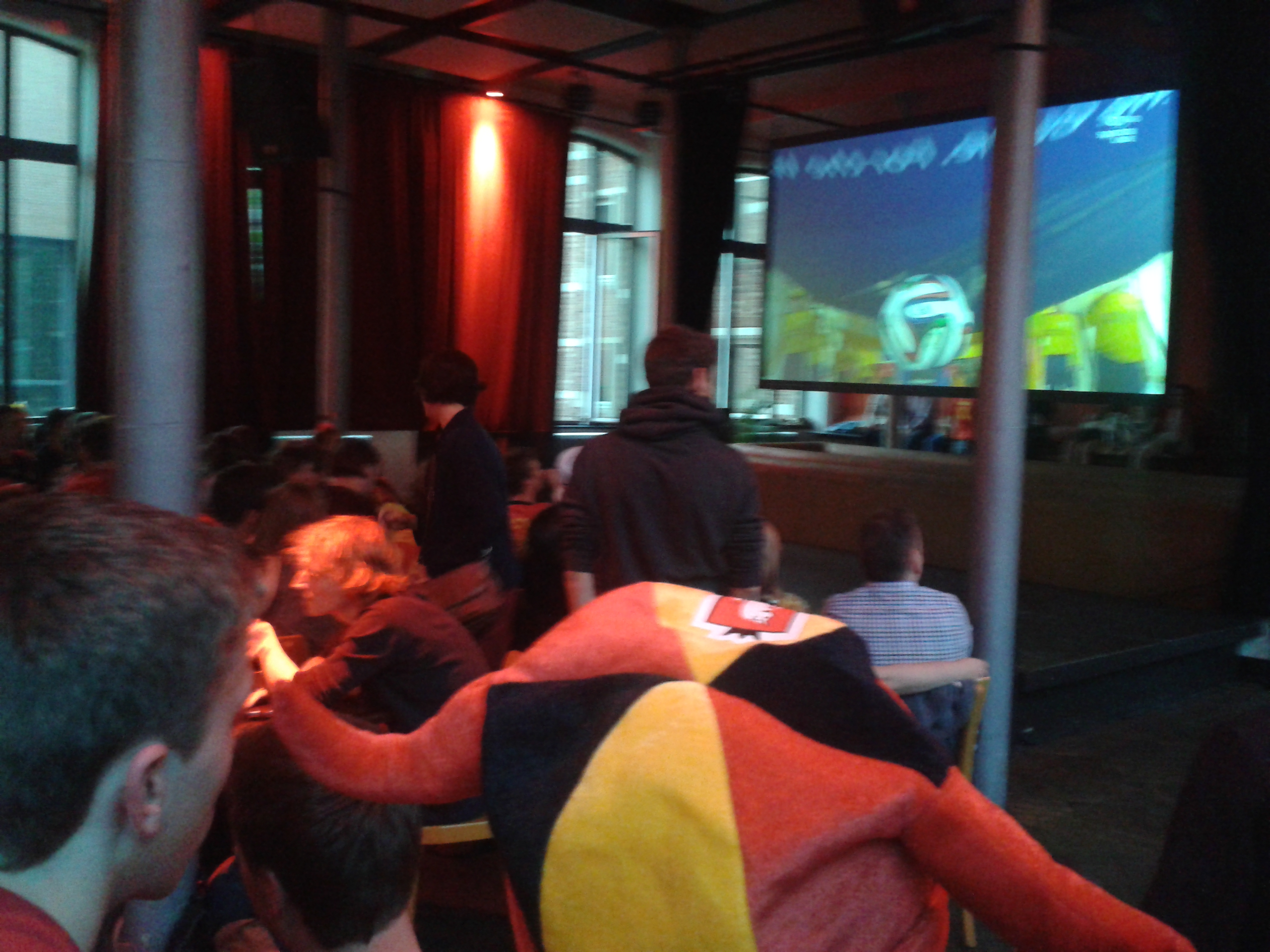
Then came 2010. We watched Germany play in the dffb cinema. Everyone was cheering for the Germans as they obliterated Australia (and later, Argentina) with crazy numbers and cliched efficiency. Every one of my fellow students knew the players’ names by heart, and I was sitting there awe-struck at one simple realization: For 90 brief minutes, everyone was pulling in the same direction. They all wanted Germany to win.
To me, this feeling was completely new. How could people with an actual education and aspiring a degree in the arts watch this shit? And: Why was I enjoying this so much? What was suddenly so awesome about seeing the German flag in places besides creepy NPD-ridden rightwing Datschas?
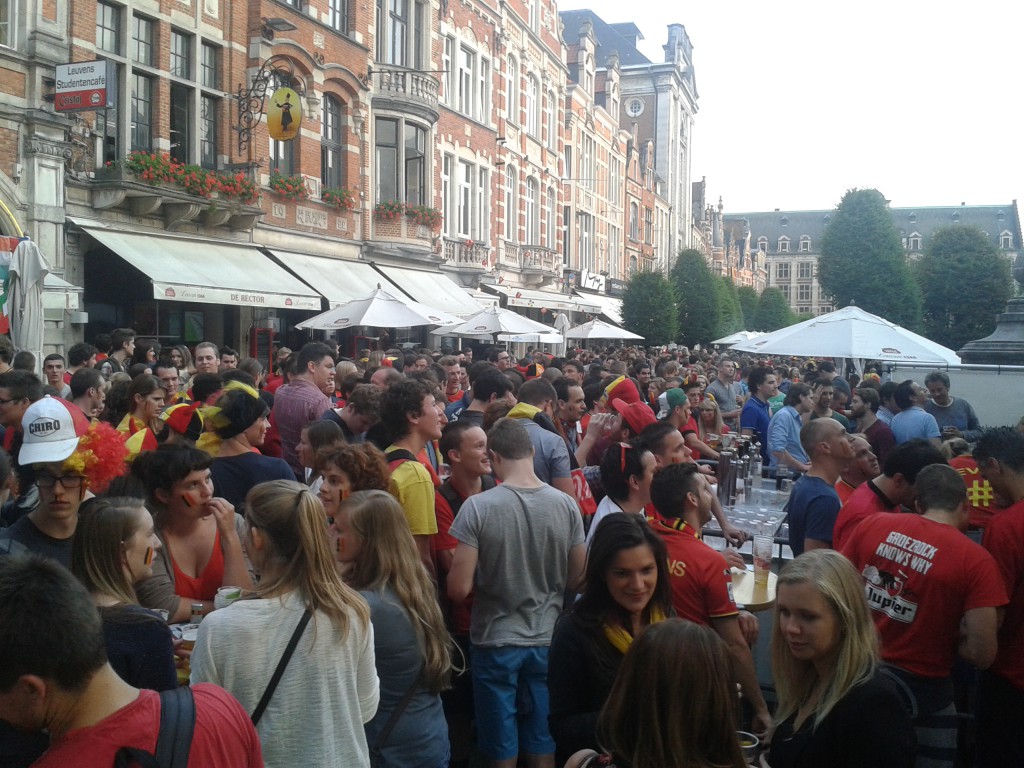
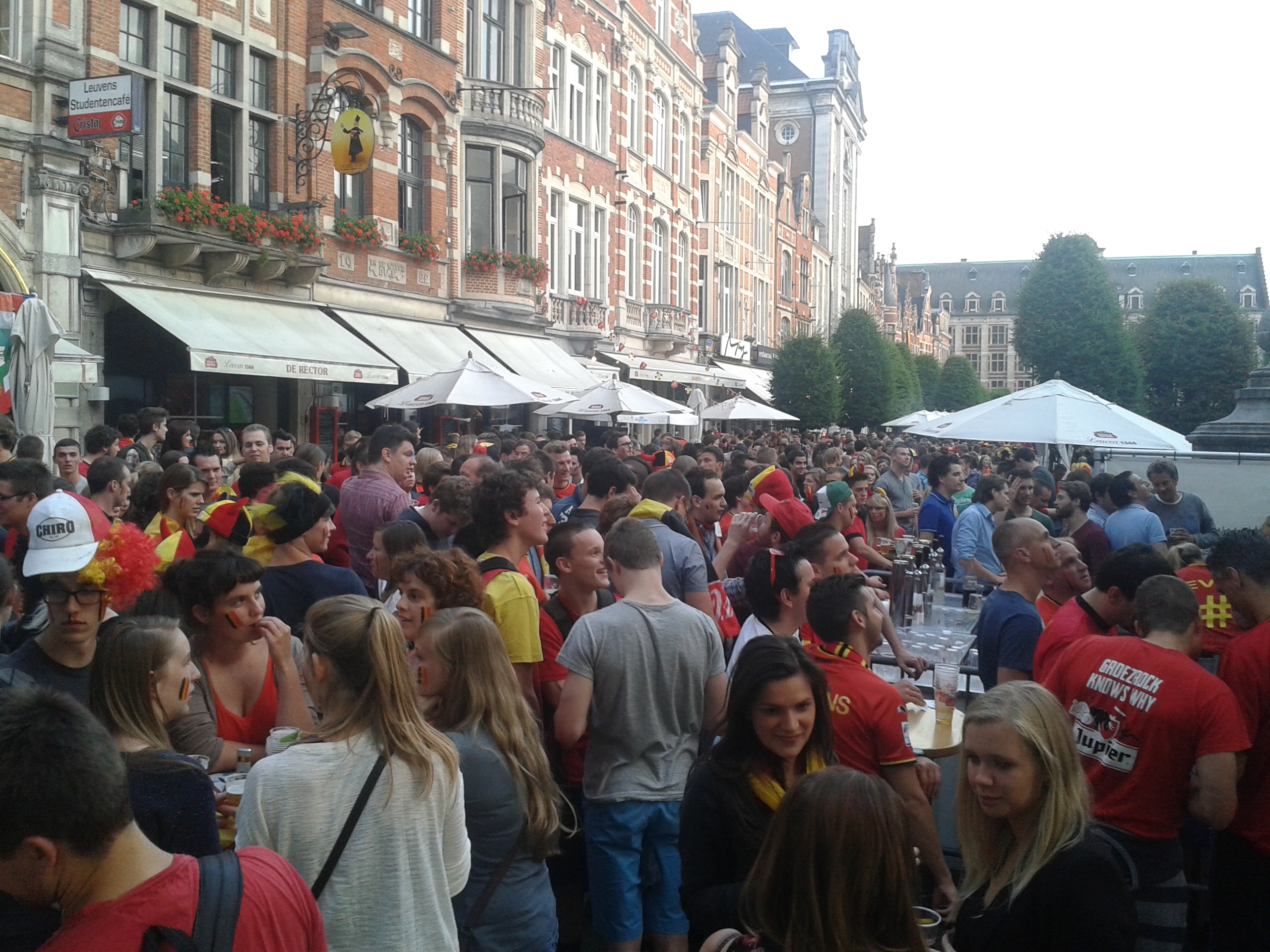
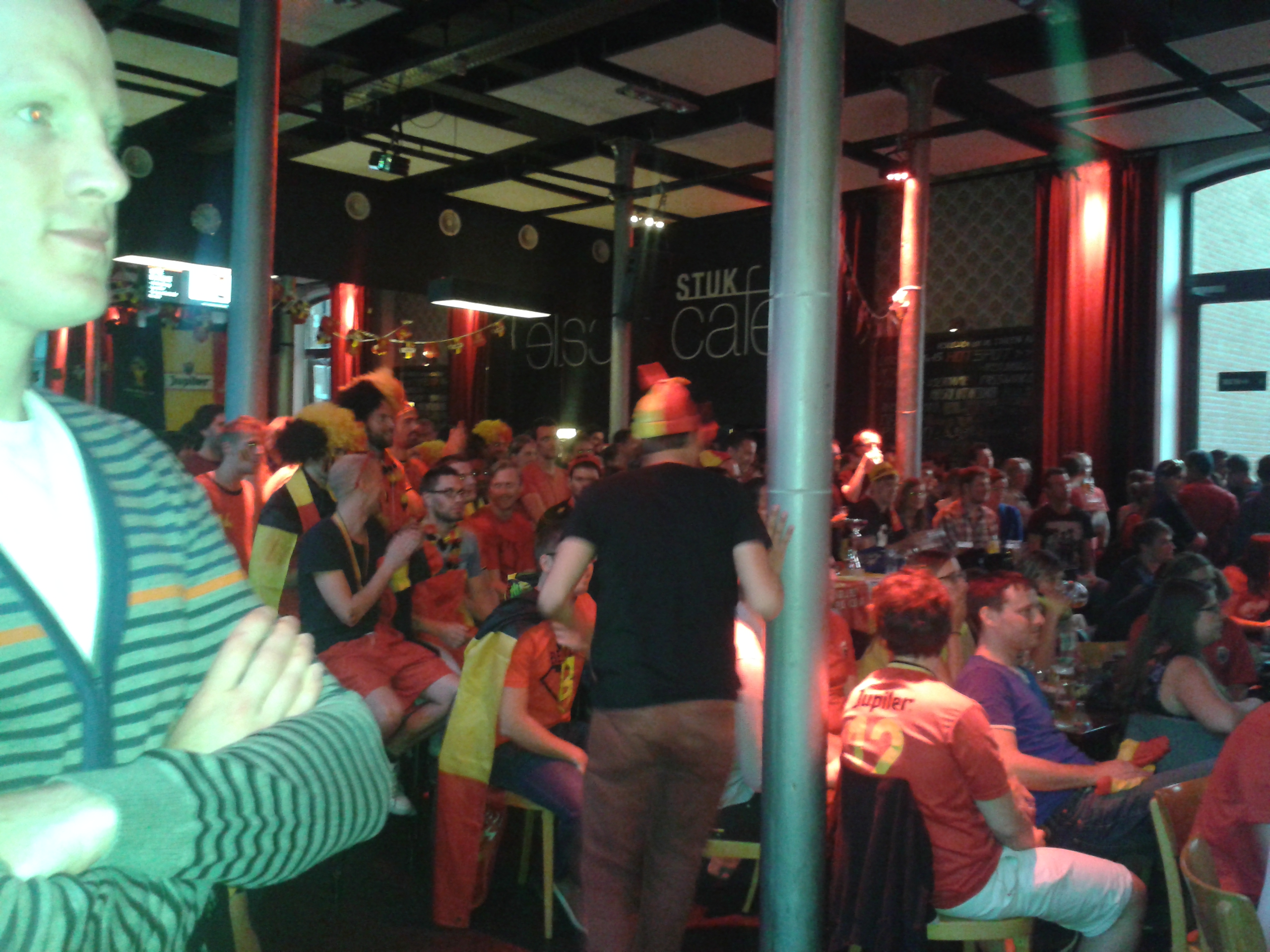
I happened to be in Belgium last week as the Devils were playing South Korea. Everywhere I looked: Belgian flags. An entirely different experience: A year prior, the Belgian flag was a things hung by Belgicists in Brussels, people who wanted the politically troubled country to stay together against all odds. Unlike Germans, the Belgian flag-wavers were rarely right-wing. Same same, but different.
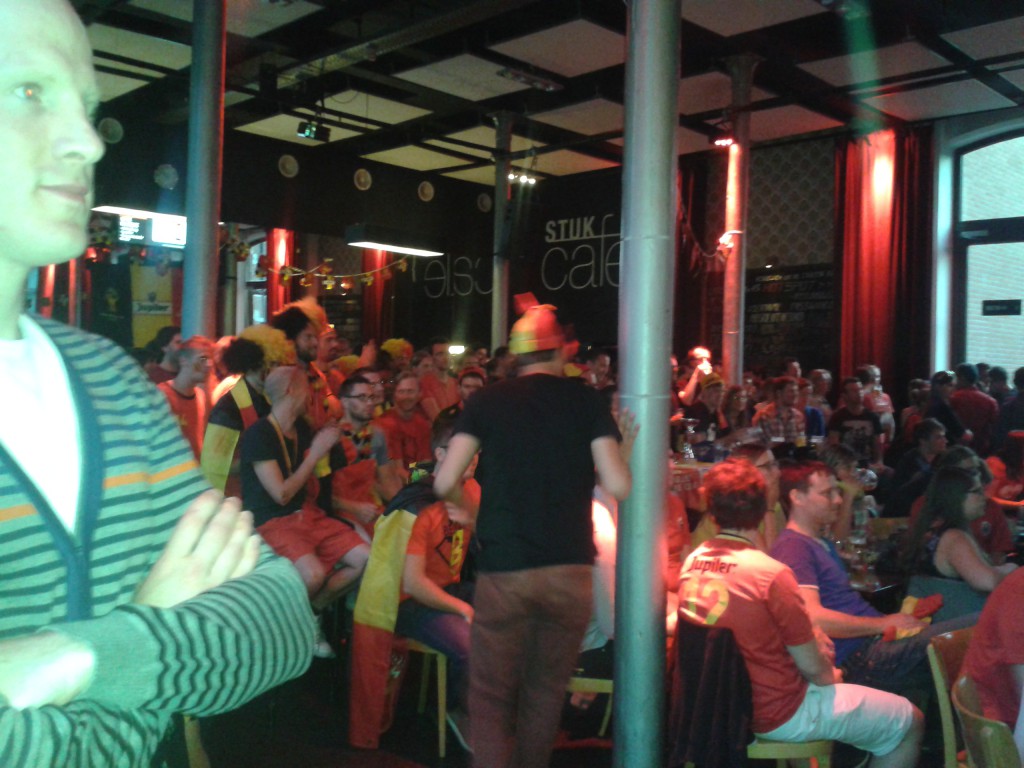
Listen – I’m not fooling myself. I know how this stuff works. I know the German flag will be back to its nutjob self by the end of next week. And hence, the Belgian flags will be gone by the time we properly lose the Argentina this Saturday (Yes! I said it!).
And we’ll go back to being cynics.
We’ll all be (rightfully) pointing fingers at FIFA for their decadence and their Saturday morning cartoon evilness. Being proud of your country – “Nationalism” – will go back to the extreme one-liners from before: A gateway to Nazism in Germany, financial and cultural ruin in Belgium. It will not be a term to describe rooting for a silly team in a meaningless sport – or, in other words: “Having fun”.
But like every World Cup, I have a the tiniest bit of hope that a little bit of that excitement, of that thrill of togetherness, will remain. It usually doesn’t. But I know that come 2018, everyone will dig their fancy shirts out of their dressers and go: “Oh, I remember that. That was fun. Let’s do that again. Let’s go to a bar, get pissed and chant Origi, Origi, Origi!”
Looking forward to that already.

-
X-Men: Days of future Past
I grew up with X-Men. The cartoon ran after I got home from school, and while it wasn’t brilliant, it was enough to get me acquainted with the most basic X-Men stories. I knew about Jean Grey and the Phoenix, had a pretty tight grasp on the Wolverine origin story… but none of these stories was quite as awesome to me as Days of future Past, in which the X-Men travel back in time to eradicate the Sentinels at their core.
It was my first time travel story. I loved every bit of its twists and turns. And I also loved the movie adaptation – but for a wholly different set of reasons. Maybe I grew up?
Sure, the time travel was as sweet as ever – but really, let’s not kid ourselves: It was mainly a trick to get some sweet Patrick Stewart and Ian McKellen action going. Sure, it worked, and they did provide a nice contrast with the past versions of Magneto and Charles (Fassbender and McAvoy, sexay as ever!), but ultimately, the story would’ve worked without the time travel shenanigans.
On the other hand, Days of Future Past expanded upon First Class, where our good friend Fassbender Magneto caused the Cuban missile crisis. Expect Richard Nixon, a mutant-related JFK conspiracy and some awesome Super 8 footage of Mystique with an afro.
So I guess Days of Future Past is a double time travel, in a way. Add to that a tight, unpretentious screenplay that has a very precise grip on the characters inhabiting it and you’ve got a solid two-hour rollercoaster ride to enjoy with a bag of popcorn and a coke. And that’s precisely how I like my X-men.
-
Godzilla
It’d been a while, but it happened for the first time since Peter Jackson’s King Kong: I fell asleep in the cinema. During the epic climax of the movie, no less.
Victim this time: Godzilla.
I wonder what it is about Monster movies that makes me drift off. Is it the vibrating bass in the monsters’ epic shrieks? Or maybe it’s the spastically moving CG-camera that rocks me to sleep? Or perhaps it’s the unbelievably stupid characters and dialogue?
Nah, it’s just me getting old.
(In all seriousness: Godzilla was quite okay. The plot was good enough, the dialogues were terrible – not even Bryan Cranston could save them – but nobody cared, and I loved the design for the epic monster: bulky, bearlike, almost hugable – until it shoots lasers from its mouth. Yet most importantly, Godzilla respected the ground rule of monster movies that made Cloverfield legendary to me: Size only matters in comparison. In every menacing monster money shot, there was a crane, a skyscraper or a huge bunch of people to show how massive this dude really is. Awesome. Now if only they’d use this logic for their characters: “Drama is only big in comparison.” The movie is filled with bulky army dudes with no real conflict other than a bighuge lizard stepping on their stuff – where’re the normal people, other than the one relatable dude that dies after twenty minutes?)
-
Bastion&Transistor – a videogame grab bag
Here’s a surprise for you all:
I love stories.
(No way!)
I read books. Comic books. Watch movies. TV shows. Listen to obscure audio games while jogging. And I play a boatload of videogames. Now each of these media are perfect for a certain type of story. Books have a certain poetry movies will never ben able to have, movies have the great potential of telling a story through moving pictures.
But what about video games? What can video games do storywise that movies cannot? How do you optimally tell a story through a series of player actions?
Most mainstream games act like makeshift movies: They allow gameplay for a bit, then they pause the action to turn you, the player, into a viewer to show you through the magic of a cutscene how the story continues. It’s about as elegant as using text overlays to gap two scenes in a movie.
And it’s a shame, too, because in theory, video games have the most potent storytelling power of all time: The power to put you inside it.
To me, that seems to be the essence of what Supergiant Games, makers of the superb Bastion, seemed to try. Bastion told you the story of its world as you were exploring it. The time spent on cutscenes and gameplay interruptions was minimal. As I approached the game’s finish line, I felt both excited and immersed – not because the story was brilliant, but because of its flawless execution inside the medium it served.
Warning – this is where I get spoilery about Supergiant’s newest game–
Transistor, their newest baby, tries to take this experiment even further – in that it doesn’t really tell a conventional story at all. There’s no real introduction, no overt conflict, there’s no explanation who the characters are… everything is up for grabs, letting you discover it by playing the game.
It’s an interesting idea in theory, but unfortunately it doesn’t really work that well. By the time I figured out the main character was running through a disappearing world to avenge her lover with a sword that embodied his soul, the game was over. Had I known this up front, I would’ve been invested to hell and back – but nope, the game keeps everything shrouded in mystery. There is a reason I spoil it here – it’s basic stuff you should know up front when diving into this brilliant game. It’s the only mistake the game makes. Other than that, you’re looking at a six hour-long gem with awesome visuals, great dialogue, superb music and engaging gameplay.
Everytime I play through the (short but sweet) game, I discover more of its interesting and touching story. With every minute, the game gets better. This is awesome – because it does this through my playing the game. By combining the many skills the game throws at me and interacting with objects in the game world, I get rewarded with pretty pictures, cool sounds and actions that make my heart skip a beat. By now, the final moments of the game move me deeply instead of confusing me. Press button -> stuff happens.
So please, next time, Supergiant Games, please, just a tiny tip of the iceberg up front. Just enough to clear away my confusion and make room for my emotional immersion.
And then you will have made the perfect example for how to use the videogame medium to tell a story.