Category: Games

Stuff about games.

  • Final Fantasy XV

    Is it wrong to be super excited about Final Fantasy XV? Can I be excited about Final Fantasy at all, now that I’m not a teenage Japanophile anymore?

    I mean, look at that trailer!

    That’s a trailer to be excited about?
    Right?

    But still, I’ve been burnt so many times by poor stories, terrible voice acting and horrific editing. Some serious Final Fantasy related backstorywound lies on my heavy soul. I still shudder when I think of twelve’s blandness, thirteen’s idiocy – and the sequels! So many sequels!

    Sure, fourteen’s been a roller coaster ride. But it’s online, Final Fantasy. And online doesn’t count.

    Can you do it, Final Fantasy?
    Can you make me love you again?
    It’s like you’re on my doorstep with flowers and chocolates, rain drops splashing on your leather jacket.
    And even though I know you will probably end up drunk on my couch watching porn and I will wonder if I deserve not to be loved, I’m gonna to let you in.

    Please. Be gentle.

  • Majora’s Mask

    Majora’s Mask

    Allow me to give you the lamest shock ever: I’ve played pretty much every Zelda game. I kicked blue knights’ ass in Adventure of Link, I spanked the Dark world and Lorule, showed the underwater Hyrule who’s boss and went back and forth through time more than I can remember.

    But I have never. Ever. Ever. Played Majora’s Mask.

    Which is weird, because I absolutely adored the concept: A compact world where you get three days to do as much as you possibly can before the moon crashes onto the earth and wipes everything out, forcing you to turn time back to the beginning.  (I don’t watch Doctor Who, but I think wibbly-wobbly timey-wimey is in order.)

    It just never happened.

    Until the most elementary schoolish thing happened: I got it for my birthday. It was wrapped and everything – I can’t remember when I last unwrapped a video game! Hell, I didn’t even know they still came in boxes!

    So I’ve been plowing through Majora’s Mask. And loving it.  Dark, twisted, hilarious… And an absolute blast to play.

    Thanks, friends, for knowing that you’re never to old to feed your inner child.

  • Grim Fandango

    Grim Fandango

    Double Fine rereleased Grim Fandango!

    Now, of course, you might not be a huge nerd like me, so this might just be five words, four of which make no sense – but to me this is a pretty big deal. Grim Fandango – a Lucasarts adventure game from 1998 about crime and corruption in the land of the dead – was a huge part of my youth, one I couldn’t experience anymore because the damn thing wouldn’t run properly on modern PC’s.

    A brief story sketch: In this game, you take on the role of Manny Calavera, a travel agent in the land of the dead – a place all souls must traverse before reaching peace in the ninth underworld. You follow him on his epic journey looking for a woman named Mercedes Colomar, whom he erroneously gave the wrong travel package – and as you do, you uncover a network of organized crime. The game is filled to the brim with film noir references and spectacular writing. It’s safe to say Grim Fandango remains, to this day, the best-written adventure game, with strong dialogues, amazing characters and a story concept that manages to be witty and dramatic at the same time.

    Yet knowing what happened between 1998 and 2015, Grim Fandango feels like an oddity. It was a expensive production, one that flopped financially, and that put the final nail in the adventure game’s coffin. People were done with adventure games – the move in the three-dimensional worlds created much more exciting ways of interaction, and adventure games started to feel stale and weird in comparison. For all the praise I’m giving Grim Fandango, upon replaying it I cannot help but facepalm at some of the puzzles. I mean, come on, what the hell is this supposed to be:

    It reminded me I played the game with a walkthrough back in 1998 – there’s just no fun in figuring this kind of random stuff out. One particularly vexing puzzle later in the game has you combining random pieces of dialogue from different people into a date, which you need to get a certain item. There is nothing in the game that nudges you towards the right solution.

    That said, I’m incredibly happy Grim Fandango was rereleased. It’s a true classic, a somehow timeless piece of art that showcases an era, and the height of a genre that was inevitably on the way out. You can get it on GOG.com, and you really should.

  • Wolfenstein – the New Order

    Wolfenstein – the New Order

    Lot of stuff happening at the moment. Writing, reading, planning… It’s kind of crazy. Yet admidst all this chaos, I still find time to play a game — in this case, Wolfenstein: the New Order. And it’s pretty brilliant.

    We all know Wolfenstein from the first person shooter that changed the world back in the nineties. Suffice to say the franchise has fallen from grace since then — that is, up till now.

    I don’t want to spoil too much, but New Order takes place in an alternate universe where Nazi Germany dropped an atomic bomb on Manhattan and in doing so, won World War 2. From this general idea stems a dystopian world in which the Nazi ideology is taken to its horrible extreme.

    The thing is: We’ve seen this before. There’s tons of movies in which the Nazis are made into a depersonalized science fiction-like threat. In that aspect, New Order is no different: its world is grey and menacing and its inhabitants stereotypically amoral. Yet New Order does something right a lot of other games do wrong: It creates a compelling main character in B.J. Blazkowicz.

    Blazkowicz (voiced by a downright amazing Brian Bloom) is a seriously troubled character, haunted by the demons of war – and amidst the gargantuan action pieces, the game takes its time to let the character breathe. He whispers to himself. He starts a tragic wartime relationship. And whatever he does, the game never gives him a break. He’s the essence of a tragic character.

    In this way, the game reminds me of the excellent Spec Ops: The Line. Yet whereas The Line was pretty balanced in its evolution from heroic shooter to apocalypse now, taking baby steps and then chucking us head-first in the abyss, New Order takes a different approach: It nearly suffocates us with its horribleness and then lets us catch a breather — before starting the whole process over again.

    The game’s out on Steam and on pretty much every console. I recommend the international version, which switches between brilliant directed German, English and Polish as you blast your way through Europe. Plus, the German language version is obviously censored – albeit slightly.

    Oh, right, the whole gameplay with shooting dudes thing is also done quite well if you’re into that sort of thing. But who cares about gameplay anyway…?

  • For Shovelry! Shovel Knight

    For Shovelry! Shovel Knight

    If anyone had told me a year ago that the best videogame story would be told in an indie game about a knight with a shovel instead of a sword, I’d have called them crazy. Even now, I think there’s something off-puttingly internetty about that pitch – like bacon, cake or lolcats, it seems to mistake weird for witty. Shovel Knight promised to be a bad one-note joke that’d run for ten hours of gameplay but be stale by the end of the first level.

    I guess promises are made to be broken.


    Watch me play some Shovel Knight!

    Shovel Knight, a crowdfunded indie game by developer Yacht Club Games, is a sidescrolling platformer in which you take on the role of the titular hero – a knight in shining armour brandishing his mighty shovel – and are tasked to find your buddy, the less creatively named Shield Knight. Everything about this game oozes with homage to the Mega Mans and Super Marios of the eighties. Pixelated graphics, chiptune music, tight and limited controls… It’s all there.

    Yet underneath this old-timey coat hides a deceptively modern game – one that’s a lot less painful to play than the platformers of yore. There’s some customization to be had, some surprisingly complex boss battles (given the nature of the game) and a good checkpoint system – which is much needed, as Shovel Knight does not kid around. This game gets balls-bustingly hard, especially in the later levels. Not rarely did I throw down the controller in absolute frustration for missing a jump or dying at the hand of a boss. Yet however angry I got, the game was never in any way poorly designed or unfair. Shovel Knight’s controls are perfectly fine-tuned, enabling some true Mega Man-esque pixel precision play.

    In a day and age where sidequests and padding are the name of the game, it’s rare to come across a game that’s streamlined and lean. Make no mistake: A lot of time and effort has been put into making this game the way it is. Shovel Knight succeeds in the basic rule of art: making the creation seem easy.

    The same leanness goes for its wonderful, no-nonsense story. Find your buddy. Save the world. There’s no unneeded complexity – just some good ideas and a game that sticks with them. Where Shovel Knight’s story especially shines is in its world-building: It takes the random-seeming shovel joke and creates a world around it.

    There’s no other shenanigans to be had: Inhabited by colourful characters of all shapes and sizes (there’s even a trout shaped like an apple), the world feels like a mix between the early Zelda games and a Saturday Morning cartoon. Sure, jokes are cracked about your odd weapon of choice, but they’re varied, earnest and cute. Shovel Knight has little to no cynicism to share: It’s a fairy tale about a hero saving the world. It doesn’t mock or judge or ridicule, not does it try to be cool or daring. Nope: Shovel Knight is courageously normal.

    Shovel Knight is a very confident-feeling game. The gameplay is top notch, the story is consistent and straight, the presentating is breathtakingly retro. Every little cog in this machine fits together perfectly, making for a wonderful ride. You can get it on steam, and I suggest you do so. There’s no excuse – the game’s dirt cheap.

    Half-past-random verdict:

    Forteen out of forteen pixellated shovels.

  • Warlords of Draenor: The Ouroboros of Addictive Gaming

    Warlords of Draenor: The Ouroboros of Addictive Gaming

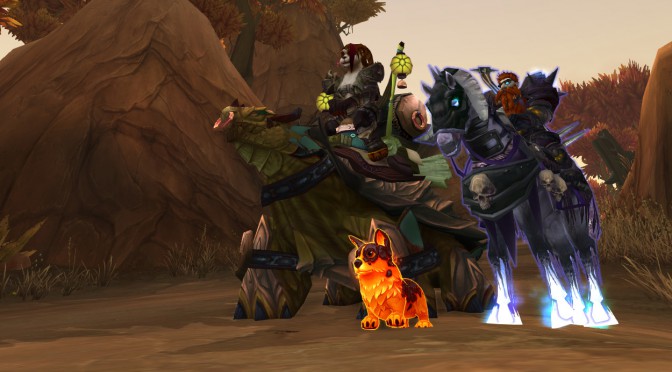
    Pictured above: Totoron, my level 95 Pandaren Monk in World of Warcraft – the only game that lets me play a humanoid panda bear riding on a dragon turtle accompanied by an evil-looking dwarf on an undead horse and a cute little puppy that’s secretly made of lava.

    Unless you’ve been living under a rock or if you have nothing to do with videogames (like most of my readers), you might have heard about Warlords of Draenor coming out. This new WoW expansion features a new iteration of an old continent, a lot of cosmetic and quality of life changes and most importantly: Garrisons – your own private base, with its own followers you can send on missions or work orders for them to complete.

    Now, for most people World of Warcraft is a source of evil (in fact, writing this post will probably get me branded a no-life for the rest of my life). Debuting in 2004, it immediately rose to immense popularity by being the equivalent of gaming crack. Marriages were broken, children fell into neglect and futures were destroyed as players farmed for fire resistance potions to finally kill that sonovabitch Ragnaros. It was a highly addictive experience, one specifically engineered to keep you playing.

    Well, guess what: It’s ten years later and the game is just as addictive as ever. The only difference: This is entirely normal now. Many free-to-play games gate their content behind long waits that can be skipped by a paywall – and of course they put the wall precisely where it’s hardest to put their game down. But it doesn’t stop there: A lot of the Assassin’s Creed games (including their newest release, Unity) have a chest that slowly fills up with cash – the speed of which depends on how many sidequests you have done. If you’ve played these games, you know how hard it is to put down the controller – you just want the chest to be a tiny bit fuller next time you play.

    And with garrisons, World of Warcraft has finally come full circle. Practically every bit of the garrison content is gated. You send your followers on missions and have to wait for them to return. You want to upgrade your base, you have to wait until the upgrades are complete. Even plants and mining ores grow inside your base on a 24-hour cycle.

    And every 24 hours, I want to log on and do five minutes of mining. And of course I’m curious to see whether my followers have successfully completed my missions. And while I’m at it, hey, those upgrades aren’t going to click themselves!

    God damn you, Warlords of Draenor, you snuck mobile gaming into my WoW. You have truly created a monster. A wonderful and awesome monster. Something preciousss

    (P.S.: I will probably do a write-up on Warlords’ story once I’m done with most of it. So far I’m halfway through and I’ve seen some interesting things done by a company that’s made more than one dramatic mistake in the last couple of years…)

  • Crypt of the Necrodancer

    Watch me suck at the wonderful roguelike rhythm game “Crypt of the Necrodancer”:

  • Hear that? That was the sound of the fourth wall breaking.

    I’ve never really been a fan of the Call of Duty games. It’s not gamer snobism (after all, I still play WoW after nearly ten years) – I’m just not really invested in realistic shooters. The stories never really seemed to click with me, just like war movies don’t click. Yet the newest game in the CoD franchise did something I find very interesting.

    This fascinates me beyond belief. How could anyone think this was going to work? I mean, the idea is right – press button, get emotionally invested – but the execution is just laughably bad. The whole trick of writing a moving story is never telling your audience it’s moving at all. Stories are emotional manipulation, sure, but you don’t want the audience to realize that. Suspense of disbelief, people!

    Imagine watching the Lion King (and I’m taking this example precisely because the movie already borders laying bare its extreme means of manipulation). Mufasa dies. Simba cries. Violins play, the choir sings some notes in flat.

    Then, suddenly, one of the wildebeasts halt and goes “Whoa, dude, your dad is totally dead, that’s like, super sad.”

    Sure, you think of these things when you’re writing a screenplay. You know you’re going to manipulate the audience to the moon and back. In fact, these are usually the moments I find first, because they supply the emotional grounding for a project. But if you’re any bit decent at telling stories, you’ll be subtle about it.

    Narration in video games is taking baby steps. I mean, there’s games like Bastion or Braid, who try to use the medium to tell adequate stories, and I think we’re really going places. But then there’s sequences like this – sequences in productions that cost so, so, so much money. Sequences that fall flat because they break universal narrative rules that have been around for millenia in the dumbest manner possible.

    Hey, at least we learned something, right?

    (P.S.: Giantbomb did a great piece on this – clickie!)

  • Bastion&Transistor – a videogame grab bag

    Here’s a surprise for you all:

    I love stories.

    (No way!)

    I read books. Comic books. Watch movies. TV shows. Listen to obscure audio games while jogging. And I play a boatload of videogames. Now each of these media are perfect for a certain type of story. Books have a certain poetry movies will never ben able to have, movies have the great potential of telling a story through moving pictures.

    But what about video games? What can video games do storywise that movies cannot? How do you optimally tell a story through a series of player actions?

    Most mainstream games act like makeshift movies: They allow gameplay for a bit, then they pause the action to turn you, the player, into a viewer to show you through the magic of a cutscene how the story continues. It’s about as elegant as using text overlays to gap two scenes in a movie.

    And it’s a shame, too, because in theory, video games have the most potent storytelling power of all time: The power to put you inside it.

    To me, that seems to be the essence of what Supergiant Games, makers of the superb Bastion, seemed to try. Bastion told you the story of its world as you were exploring it. The time spent on cutscenes and gameplay interruptions was minimal. As I approached the game’s finish line, I felt both excited and immersed – not because the story was brilliant, but because of its flawless execution inside the medium it served.


    Warning – this is where I get spoilery about Supergiant’s newest game–

    Transistor, their newest baby, tries to take this experiment even further – in that it doesn’t really tell a conventional story at all. There’s no real introduction, no overt conflict, there’s no explanation who the characters are… everything is up for grabs, letting you discover it by playing the game.

    It’s an interesting idea in theory, but unfortunately it doesn’t really work that well. By the time I figured out the main character was running through a disappearing world to avenge her lover with a sword that embodied his soul, the game was over. Had I known this up front, I would’ve been invested to hell and back – but nope, the game keeps everything shrouded in mystery. There is a reason I spoil it here – it’s basic stuff you should know up front when diving into this brilliant game. It’s the only mistake the game makes. Other than that, you’re looking at a six hour-long gem with awesome visuals, great dialogue, superb music and engaging gameplay.

     Everytime I play through the (short but sweet) game, I discover more of its interesting and touching story. With every minute, the game gets better. This is awesome – because it does this through my playing the game. By combining the many skills the game throws at me and interacting with objects in the game world, I get rewarded with pretty pictures, cool sounds and actions that make my heart skip a beat. By now, the final moments of the game move me deeply instead of confusing me.

    Press button -> stuff happens.

    So please, next time, Supergiant Games, please, just a tiny tip of the iceberg up front. Just enough to clear away my confusion and make room for my emotional immersion.

    And then you will have made the perfect example for how to use the videogame medium to tell a story.
  • Well there’s no skin on it either.

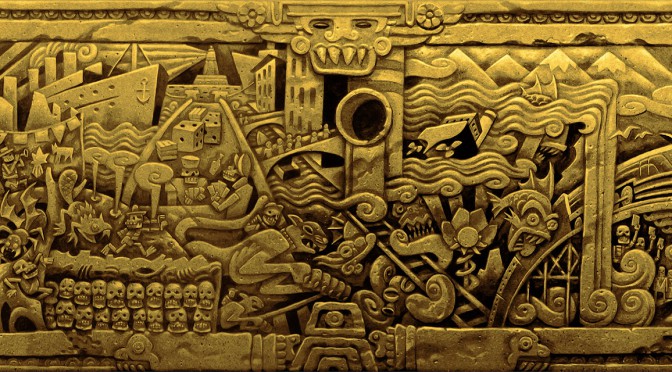
    So yeah. If you look past the weird dude with the glasses – it’s Grim Fandango!

    (For those who have no clue what I’m talking about, I’ll probably do a write-up on this old game, because it’s only the greatest game ever made.)