
Category: Books & Comics

Stuff about books.

  • Why Should You Need to Read Book Everyday

    Why Should You Need to Read Book Everyday

    It’s no secret that the digital industry is booming. From exciting startups to global brands, companies are reaching out to digital agencies, responding to the new possibilities available. However, the industry is fast becoming overcrowded, heaving with agencies offering similar services — on the surface, at least.

    Producing creative, fresh projects is the key to standing out. Unique side projects are the best place to innovate, but balancing commercially and creatively lucrative work is tricky. So, this article looks at how to make side projects work and why they’re worthwhile, drawing on lessons learned from our development of the ux ompanion app.

    People think focus means saying yes to the thing you’ve got to focus on. But that’s not what it means at all.

    Producing creative, fresh projects is the key to standing out. Unique side projects are the best place to innovate, but balancing commercially and creatively lucrative work is tricky. So, this article looks at how to make side projects work and why they’re worthwhile, drawing on lessons learned from our development of the ux ompanion app.

    Why Integrate Side Projects?
    Being creative within the constraints of client briefs, budgets and timelines is the norm for most agencies. However, investing in research and development as a true, creative outlet is a powerful addition. In these side projects alone, your team members can pool their expertise to create and shape their own vision — a powerful way to develop motivation, interdisciplinary skills and close relationships.

    Building into the identity and culture of an agency can also lead to new client work. These projects act as a road map, showing clients exciting new technologies and ideas that will differentiate you from competitors. One of our earliest projects turned our website into a brochure, optimized for the first iPad’s touch interactions. By demonstrating the final product, we went on to win a project to create a similar product for a new client.

    A significant shift in mindset is required to support either type of side project — weighing the longer-term, incremental benefits against committing what would otherwise be immediately billable time. Many agencies do this with a time-bound model of 80% client time versus 20% time, inspired by Google’s successes with Gmail and Google Reader which they have since (tellingly) phased out. I’d instead recommend the following guidelines.
  • Spirou

    Spirou

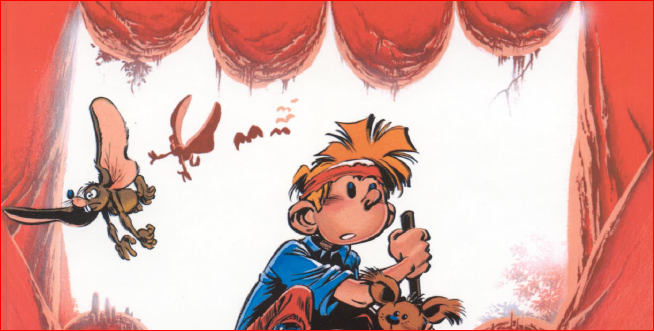
    After many years of living in Berlin, I finally managed to bring over my comic book collection. Like practically any Belgian kid, I used to be pretty hardcore about collecting these – and even though I later moved over to manga and US comics, my old collection still holds a special place in my heart.

    Back then, I mainly had a thing for Spirou and Fantasio (or Robbedoes en Kwabbernoot as they were awkwardly called in Dutch). These adventures, who reached fame penned by the legendary Franquin, simply spoke to me, and I devoured them endlessly. Later, as the characters drove Franquin into depression and he moved on to other projects that were no less brilliant, other artists took over with varying success. Along with the artist, the art style and the adventures changed.

    When I was a kid, these artists were Tome and Janry. I loved what they came up with. Along with them, they sent Spirou fighting against a robotized Marylin Monroe, changed the colour of his skin, sent him to a mob-overrun post-iron-curtain Moscow… and into the Vallée des Bannis.

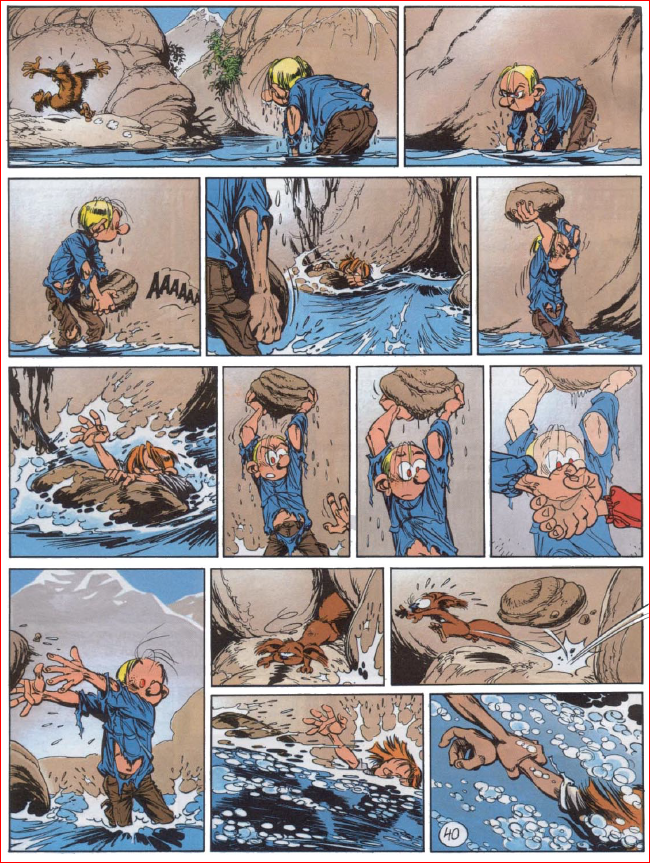
    That was my favourite album. In it, Fantasio would get stung by a poisonous mosquito, which rendered him uncontrollably aggressive. Suddenly, the friends became sworn enemies, as Fantasio was sick of standing in the hero’s shadow. If Spirou were to die, Fantasio would be the hero instead of the underdog! Of course, ultimately, friendship conquered all. Spirou and Fantasio were, after all, best friends. But it was the way Tome and Janry chose to frame it that made it special.

    Spirou
    (That hand thing is a reference to the very start of this book, where our two heroes reach out for each other as they are stuck in the dark.)

    I had never seen anything like it. There was no text – only a highly cinematic piece of visual storytelling. Up to that point, I had seen comics as novels with pictures in them, where text balloons were used to get a point across. But that one page changed the way I thought about comics for ever.

    And it continues to do so to this very day.

  • Slaughterhouse Five

    I’m so sorry. I feel so bad. Remember this post? The one where I went on and on about what shitty pulp books I liked? Turn out I forgot to mention my all-time favourite book and the only one worth a damn on that list:

    Slaughterhouse Five.

    You might ask yourself:
    “But Bert, why tell us this now, more than a month after the last post?”
    (You might also ask yourself “But Bert, why did you lie?” with a tear in your eye, to which I say “Hush little one, it’ll be alright.”)

    Because I stumbled upon this great summary of why Slaughterhouse Five is so great. Thanks, John Green!


  • The fault in our stars

    Sometimes, the universe has a funny way of bringing things together. It’s the premise of every movie involving a car crash — and it’s how I ended up reading John Green. I had watched hundreds of Youtube videos of him explaining the history of the world, eyerolling every time he started talking about “his books”, thinking that this guy must be a pretty poor writer if he needed a Youtube history channel to promote his novels, yet somehow failing to realize his book is lying right next to me and it is friggin’ awesome.

    So you could say that that book – The Fault in our Stars – is my Amores Perros, my Crash, my Thelma and Louise (or wait, no, that one’s an entirely different car crash).

    Go read it. Even if it’s about fifteen year-olds with cancer, has no violence and features the worst kind of Americans in the world: The ones visiting Amsterdam. I know there is no possible pitch that will make you voluntarily read this book – but if the mind control powers I got by achieving rank 7 at my scientology meetings work, that should be no problem.

  • Books!

    I’m back from the USA — and apparently people want me to list books or else I’ll face the wrath of some sort of a bucket of ice or books or whatever. (I feel so out of touch with the internet.)

    In no particular order:

    1984: I read this on a long train ride and was so immersed I cried out when the conductor suddenly asked for my ticket.
    The Stand (Stephen King): Read this sitting under a tree in Bourgogne, France, instead of getting drunk on awesome wine. While the ending is kind of meh, the first 700 pages are the best set-up to an apocalypse I’ve ever read.
    Watchmen (Moore & Gibbons): The first time I connected fascism and superheroes. My world has never been the same since.
    20th Century Boys (Naoki Urasawa): My great obsession during university. Funnily enough, I cannot for the life of me remember who the enigmatic “Friend” turned out to be in the end, but the constant tension in this manga was awesome enough to make it on a list comprised of books.
    Vallen (Anne Provoost): I read this for Dutch class when I was 14 and I still consider it one of the best Dutch books I’ve ever read. Oddly enough, when I read it nowadays it’s a completely different novel – I must’ve ignored the political side of the story back then.
    Momo (Michael Ende): First book I read in German. It’s awesome (and so much better than the never-ending story – sorry!)
    The Golden Compass (Philipp Pullman): While I think The Subtle Knife and The Amber Spyglass veer too much into philosophical discussions, the Golden Compass is to me the perfect mix between religious critique and pulpy fantasy.
    The Amazing Adventures of Kavalier and Clay (Michael Chabon): I think this is the best book I’ve ever read. Also it makes me feel smart because it won a Pulitzer.
    Harry Potter and the Goblet of Fire (J.K. Rowling): What can I say? I love pulp! The moment Cedric Diggory dies was one of the greatest in the series – in two sentences, child literature grew up, with no forewarning. All the impactful plot twists of the later books never achieved the pure shock this moment caused.
    Tuesdays with Morrie (Mitch Albom): Of all the books listed here, this one connects most to me personally. There’s something about the intimacy of Morrie’s slow descent that gets to me everytime. Together with Kavalier and Clay, this is the only book ever to cease to be fiction and to just turn real.

    So there you have it. You can put your buckets away.

  • The amazing adventures of Kavalier and Clay

    I don’t really read a lot. I mean, I like to read, but it’s something I can only do when I’ve got peace of mind. I remember reading IT and The Stand on a holiday in France – tackling these mastodonts back to back was pretty much the best reading experience I’ve ever had.

    Unfortunately, The amazing adventures of Kavalier and Clay, a Pulitzer-crowned epic by Michael Chabon, couldn’t get that treatment. I started reading it at the Warsaw Film Fest last October and I couldn’t find time to finish it until last weekend.

    But here’s the thing: I wouldn’t have wanted it any other way.

    (more…)

  • Duma Key (Stephen King)

    “At first you were afraid you’d die, then you were afraid you wouldn’t. That’s what Wireman says.” (Edgar Freemantle)

    I’d had Duma Key in my hands more than once before buying it. There was always something about it that seemed to put me off. It was set in Florida. The setting didn’t really interest me. The cover said something about missing girls – meh. And most of all: it was written in first person. That’s something I’d never seen with King at that point. It reminded me a bit too much of Lovecraft, so I always put it away.

    And then, once, I actually brought it home and read it. Completely by coincidence, I guess. Good thing I did.

    (more…)

  • Under The Dome (Stephen King)

    Preface

    I know I start many a review by saying this, but I’m not a big reader. Then again, every time I check out my book review section (at one of those moments where I also have the irresistable urge to smell my own farts or worse, read my own scripts), it strikes me how big the thing has become. Surely, if you think that I’ve been writing reviews for the last four years, it’s nothing. But then again, a lot of books I’ve read are missing. Because I didn’t have the time to write something about them. Or because I didn’t have the urge. Or nothing to say. (more…)

  • The Hunger Games (2): Catching Fire (Suzanne Collins)

    When I finished reading The hunger games, I was torn. On the one hand, I wanted to know how the story went on. On the other, though, I was sad that it did go on. I wished that Suzanne Collins had wrapped up the story in one book, kind of like 1984, as one cog in the system that in the end tried to change something but didn’t succeed. Luckily, when reading the second book, it quickly became apparent that Collins did indeed have a few more tricks up her sleeve. And now I have to say that I’m relieved at her markable capability to round this massive beast up in three volumes: the second part alone was so confined that it could have easily been written into two or three books alone.

    After Katniss and Peeta came out of the Hunger Games alive, they found their world to have changed. Not only did the Capitol hate their guts and wanted to make their lives into a living hell, they found they had become the symbol of a boiling revolution. The second book is all about setting up these two plot points: pestering on the one hand, the big explosion that is due on the other.

    There’s just so much that’s going on in this world, and every character in it could easily have a book written about them, showing their point of view. Haymiss, trying to keep his two prodigies alive; Cinna, knowing that the end is nigh; Gale, leading a miner’s revolution in full-blown Guevara style… everyone is important. That’s the strength of the series: it doesn’t try to overexplain things, it just stays close to Katniss, telling everything from her perspective, so we find out things as she learns about them.

    It took a while for me to get it, though – about half a book’s worth. It’s only as the second half commences that I thought I knew where it was heading. It’s nice to get enough puzzle pieces to piece it together, but still get drawn into wrong conclusions. The story twists and turns, anything can happen, but most things you expect to happen, don’t.

    I’m eager to find out where Collins is headed with the last part. A war has now officially started, with friends in the hands of enemies. How will this go on? Obviously, District 13 will factor in what’s up next, but as it has been proven time and again: my predictions are usually wrong.

    I can’t wait!

  • The Hunger Games (Suzanne Collins)

    I’m not going to lie: I’m not a big reader. Actually, I guess I have to admit I’m pretty picky about stories in general: because I’m so interested in creating them, it’s become very hard to enjoy them without thinking how I would have done it myself. Only rarely do stories make it possible for me to switch off completely. Usually, these are the stories that break some sort of boundaries and consciously sail into the grey areas – the dubious, the uncertain, the creative, the impredictable. “The Hunger Games” by Suzanne Collins is one of those.

    It already starts when the premise of the book is stated: Katniss and twenty three other teenagers from a future world named Panem get dropped in a huge arena, where only one can come out alive. The idea isn’t clever an sich: the movie Battle Royale (or just plain old gladiators) has done it before. It’s in taking this concept seriously on an emotional level that the plot starts working: you know in advance you’re going to lose all but one of the characters you’re rooting for.

    In succeeding in this, Collins manages to create a gripping, exciting story that’s so nailbitingly tense you just won’t be able to put it down. The story twists around on more than one occasion, and delivers a satisfying conclusion leading into a second part.

    I for one can’t wait to start reading the second part, even if I am a bit weary: safe for the last few chapters, The Hunger Games was so well-rounded as a story that I don’t really want it to go on. But, when looking at the premise of the game, you know that a won battle doesn’t equal a won war – and that’s where this is leading up to…